Sunday, 23 August 2009

Black models as 'Wild Things'


So, we all know there are myriad reasons why the fashion industry is terrible for women (and I say this as a Vogue reader who wrote 1000 words on what to wear to 2008 Christmas parties). It makes us feel bad or not being sample sized, for not having enough money to buy designer or keep up season to season. But one of the things that has really struck me over the last few years of being a fashion junkie, is that it is often blatantly racist. I'm referring to the lack of black faces in magazines but also to the way black model are exotisised and fetishised when they do grace the pages.

I was going through a pretty heavy obsession with Stefano Pilati's YSL Autumn/Winter 2008 collection when I found this quote from the man himself on black models:

“To me, it is a matter of proportions and the bodies I choose. My fit model was a black model. When I wanted to translate what I put on her, it was a disaster. It would need 13 times more work in the atelier to modify it to put on a more Caucasian anatomy. Sometimes, it’s not your choice. You can’t find “black models” that are beautiful and with the right proportions. I prefer them with lean proportions with no big hips.”

Wow. This is the current creative director of Yves Saint Laurent, a label who were among the first to regularly use black models in their catwalk shows. So we're supposed to accept this as an explanation? That black women never have both beauty and the 'right proportions'? I call bullshit. If Pilati can't make his clothes fit, that's his problem. He can't blame ALL BLACK WOMEN for his shortcomings. Models are considered to be the most beautiful of all women. If black women aren't represented in the industry, it's tantamount to saying they are not the right kind of beauty.

And if a black woman does make it into the big time as a model, she can expect to be treated pretty much as a novelty. A sexy, exotic novelty. I writing about this now because of this. What a surprise, the fashion industry's chosen black woman cavorting with animals in Africa. The spread is even called 'Wild Things', implying that Campbell is 'wild' like the animals that she's photographed with. All woman have suffered from this idea that women are close to nature and somehow more earthy and elemental than men, but black woman are constantly portrayed in this way. Photographs of black models are often far more sexual than those of their white counterparts, they are naked far more often. It seems to me that the fashion industry views black women as wild and sexual and white women as beautiful and ethereal.

It's interesting then that Naomi Campbell appeared naked on the cover of i-D magazine with Stefano Pilati last year. She hasn't shied away from calling the industry out on its prejudices saying,
“Women of colour are not a trend. That’s the bottom line. It’s a pity that people don’t always appreciate black beauty. In some instances, black models are being sidelined by major modeling agencies.” (

The pictures of her, naked and pressed up against Pilati fit in perfectly with the way that black models are sidelined. The things is, it is hard for black models, even those as famous as Campbell, to be constantly addressing issues around racism. What they say would no doubt be distorted by the media, and often the problems are so complex that they would never been given a platform to express them. They are expected to be spokeswomen where white models never are. There's certainly an argument to be made that if black models turned down these jobs, the industry would have to change. This isn't necessarily the case though, and in such a precarious and fickle industry, it would be easy for photographers and editors to simply replace models who refused shoots. Far more problematic though than Campbell appearing in this shoot, is Pilati's involvement. Does he really think that embracing a naked black women absolves him of racism?

Campaigning for representation of women of all ethnic backgrounds in magazines is important. What may be more important is ensuring that the industry does not get away with vile, racist stereotypes when they do decide to use black models.

(The quotes from Pilato and Campbell come from Stylefrizz.com)

Thursday, 13 August 2009

Filament magazine and the female gaze.


'Filament' is a new magazine for women which describes itself as, "72 quarterly pages of intelligent thought and beautiful men". It doesn't run articles on fashion or cosmetics and prides itself on publishing high quality, intelligent features as well as pictures of hot boys not wearing very much. Sounds AWESOME.

I love the fact that they have done their research rather than just going along with the notion that women don't find visual stimulus exciting. They found that women really wanted erotica, and that the images they wanted to see were not the same as the ones common in gay porn. They found that women wanted:

* men who are not muscle-bound
* men with more feminine face shapes
* men with attractive faces
* images that show the subject’s character and the environment he is in.


The problem is, they also found that women wanted more than just semi-nudity. They were asking to see fully naked men with erections. OK, fair enough, walk into any newsagent in the land and you'll find the female equivalent of this. Up above Cosmo, Heat, Vogue and Grazia you'll probably come face to face with a women on a magazine cover with breasts bigger than your head, grabbing at herself 'passionately'. Except their printers said they were concerned about causing offense to "the women's/religious sectors". So women are going to be offended by erections but not page three girls, religious groups are going to be more upset by a boner than a female crotch-shot? Oh, please. This is almost certainly another attempt to deny female sexuality, and to 'protect' men from it.

I'm sure that many people will disagree with me, but I tend to agree with Kristina Lloyd and Mathilde Madden at The Guardian when they say,

"But there's nothing inherently sexist about depicting nudity. It's sexist when only women are deemed to signify the erotic; it's sexist when eroticised images of women are so normalised and widespread that women stand to be viewed first and foremost as sex objects – their value inextricably linked to their sexual desirability. The sexism is in the inequality."

Don't get me wrong, I'm not a fan of the porn industry and I have a special well of hatred reserved especially for lads mags. The thing is, I don't think that all sexual images are necessarily exploitative or degrading. Nudity and sexuality shouldn't be frowned upon, after all, do feminists want to be on the same side as people who have denied female sexuality for eons? It's the industry that often deserves our scorn. 'Filament' say they are dedicated to ensuring that the men who model for them are treated fairly. Models have the right to withdraw their images and the team have even turned models away when they feel that working for 'Filament' may not be a good career move for them.

I'm willing to bet that a lot of lads mags editors would say a similar thing. The problem there is that it ignores the fact that many young women are growing up now believing that their only worth lies in their sexuality. Women's ability to really choose any involvement in the sex industry is often more problematic than it is for men because of intense societal pressures. Even women's magazines constantly impress upon women the importance of 'pleasing your man'. Women's sexuality is dictated to us by the mainstream press which defines it as passive and willing to please but never demanding. In other words, in a classically post-feminist marketable way.

I think a publication that acknowledges female desire and caters for it, as well as promoting positive body images and providing intelligent comment should be applauded. It worries me that there seems to be two main camps on porn and female sexuality: the 'all sexualised images are wrong/women don't want to look at cock' camp, which is inhabited by some feminists as well as religious and right-wing folk and the 'women are really nothing but a pair of tits and should act as such' camp inhabited by the editors of lads mags and the lads themselves. Neither positions are realistic or helpful. Although I think lads mags are beyond reform (due to the blatant misogyny of the articles that goes along with the images), I'm happy to see more women behind the camera in porn and erotica.

Friday, 17 July 2009

Is Lars Von Trier really the Antichrist?

"If you see this film you will be putting your money into something which deserves to bomb – and give a grain of validity to the sickest general release in the history of cinema." (From the Guardian)

This is Julie Bindel on Antichrist, the new film by controversial director Lars Von Trier who has been accused of, amongst other things, hating women. The film stars Charlotte Gainsbourg and Willem Defoe as parents of a child who dies tragically. They retreat to a cabin in the woods called 'Eden' in an attempt to help Gainsbourg's character, 'She', to exorcise her grief. However, as in all horror movies set in the woods, nature becomes a malevolent force and the rest of the film charts 'She''s descent into madness and self-mutilation. The film has been criticised for its depiction of graphic sex, female madness and, most controversial of all, for the scene in which Gainsbourg cuts off her clitoris with a pair of scissors. Nice.

The Guardian has an interesting article on the film entitled 'Antichrist: a work of genius or the sickest film in the history of cinema?' (which I have linked to above). It features opinions on the film from women and feminists such as Gillian Wearing and Samantha Morton who have a range of views on it, although many of them are favourable. Morton, for example, admires the performances of Gainsbourg and Defoe as well as the cinematography whilst Joanna Bourke, a History professor, is full of praise, even for the way Von Trier has depicted the violence.

However, Julie Bindel seems almost vitriolic in her hatred of this film, likening it to torture-porn movies like, 'I Spit On Your Grave' and condemning it as gratuitous and poorly acted. She says she'd like it to 'sink without trace' and bemoans its likely inclusion on Film Studies courses. I should mention at this point that I have not seen this film yet, and I'm not sure if I will as I'm incredibly squeemish and affected by horror movies. Despite this, I feel compelled to defend Antichrist from some of her heavy-handed criticisms.

Firstly, I don't understand why she would object to film students studying this film and analysing the ways in which it could possibly be a violent male reaction to 'female emancipation'. This seems to be the way Bindel herself is interpreting it. If the film is indeed as abhorrent and problematic as she says, then surely it is important that it is studied critically rather than just being allowed to 'sink without trace'.

Bindel also takes issue with the fact that she finds the violence to be unjustifiable, in that it doesn't teach us anything about why humans commit violent acts. This negates the idea that the film could be about the futility and meaninglessness of human violence. Perhaps the violence in this film doesn't teach us anything because the violence here has nothing to teach. She refers specifically to the genital mutilation scene saying,
If I am to watch a woman's clitoris being hacked off, I want it to contribute to my understanding of female genital mutilation, not just allow me to see the inside of a woman's vagina.
From what I know, this scene has very little to do with the female genital mutilation that occurs in places like Uganda. For one thing, Gainsbourg's character inflicts this upon herself through madness caused by guilt and grief. The act is surely about these themes, not about female genital mutilation itself.

If I see this film, I will probably also argue that it isn't comparable to torture-porn movies like Saw or Hostel. This film may feature graphic sexualised violence like many of these films, but it seems to be symbolic of important themes like grief and guilt rather than contextless like it so often is in mainstream torture-porn movies. It should also be remembered that Von Trier has consistently made films that push the boundaries of what is acceptable, even making a foray into the world of pornography for women. I want to believe there is a degree of artistic merit in this work, just as there is in much of his other work. I don't believe Von Trier would make a film full of gore and sex for the shock alone. Many other reviews point to a sense of desperation in the film, perhaps a desire to convey meaning and emotion that came from the poor state of his mental health whilst writing this film.

I have no doubt that this film is problematic. It features the familiar trope of the mad woman being connected to evil forces of nature which is an idea that has hurt women throughout history, and the gender stereotypes of emotional woman and rational man may turn out to be hamfisted and over-simplified. But I won't be able to tell you until I pluck up the courage to see Antichrist for myself. And I'm not sure when that will be.

Wednesday, 15 July 2009

Rape alarm

(The following article is from this blog.  I'm not really a hot news reporter so I thought I'd spare you my own attempt to write this up.  But I was one of the five women who took part in this Rape Crisis protest.  We've had a lot of support and we just hope that Boris does the right thing.  One thing I would add to the following article is that we targeted Richard Barnbrook's speech in solidarity with Southall Black Sisters. Southall Black Sisters have been forced to boycott a committee looking at strategies for dealing with violence against women because they (rightly) object to the racist, sexist homophobe Barnbrook also having a seat on the committee. You can read more about that here.)

 .
FEMINISTS released attack alarms in City Hall today in a protest calling for Mayor Boris Johnson to secure funding for rape crisis centres.

Five women smuggled the alarms through security and set them off just after 11.30am as assembly members discussed how much money should go to referral and support centres.

The protesters were wearing t-shirts painted with the slogan “rape crisis in crisis” in red as they sat in the public gallery of the GLA centre next to former mayor Ken Livingstone.

They linked arms but were eventually escorted out by security, allowing mayor's question time to continue.

Beth Evans, 22, who has just graduated from King's College and is a member of Mind the Gap London Student Feminists was among the protesters.

She said: “The total annual funding for Croydon Rape Crisis Centre is £250,000 which is the same amount Boris gets paid by The Daily Telegraph – what he calls 'chicken feed.'

“The mayor has failed to keep his promise to voters that he would increase support for women who have suffered sexual violence.

Boris was answering questions from Green party GLA member Jenny Jones about the policing of rape in London and the funding of rape crisis centres.

A consultation by the GLA on preventing violence against women, named The Way Forward, will run to Monday next week.

Evans said: “We welcome the fact the mayor is finally talking about rape crisis but at the moment everything he says sounds like more empty promises.

“We desperately hope people will take part in the consultation online and hold the GLA and the mayor to account. This is why we had to raise the alarm today.”

The mayor stated before the elections last year that he would open three new rape crisis centres and continue to fund Croydon, the only such service currently available.
Johnson promised £744,000 towards rape crisis centres during his campaign but has currently budgeted just £467,000.

The costs of the Croydon centre, which has a four-month waiting list, stands at £250,000 and campaigners fear there is not enough cash.

Laura Harvey, 27, a PhD student from south London said: “Every girl and woman who has suffered violence has the right to specialised support to rebuild their lives.

“But London only has one rape crisis centre for 3.9 million women. Only one in four councils provide this support so there is a post code lottery for women in the most desperate need of help.”

According to the latest figures, there were 1,792 rape cases in the year to 2007 of which only 7.4 percent resulted in conviction. Studies have shown that less than seven percent of rapes are ever reported.

UPDATE: Lee Jasper, former Senior Policy Advisor on Equalities to the Mayor of London, said in response to the-sauce.org article: "Ring the alarm! When the number of women being raped is n the increase I cant see how such a decision is justified or remotely defendable?"

UPDATE: The alarms were set off as Richard Barnbrook, the BNP GLA member, stood up to speak. This was to highlight a BNP member's statement that rape is "like eating chocolate cake".

Sunday, 12 July 2009

Rebel girl?


Sometimes I feel like a Contrary Mary. A lot of my favourite musicians are women, people like PJ Harvey, Patti Smith and Kristen Hersh, as well as bands like Le Tigre and Bratmobile. I even put on a clubnight, Girl Germs, with a brilliant friend, celebrating awesome music made by awesome women. You would think then that I would be pleased about the much-hyped influx of young women making records and selling loads of them.

And I guess I would be if I felt that this was at all sustainable rather than just another fad. I think these two quotes (given to the Guardian) sum up the problem:

"The best thing about it is that it's glamorous," he says. "It's more interesting than a bunch of boring blokes, singing drab bin-men music." (Paul Rees, editor of Q magazine)
"I've spoken to a couple of A&R men recently who have said 'Please don't send us to see any more girl singers. We're just so bored of them'." (Steve Lamaq)
Obviously, the answer is not to get out of the boring indie slump with better, and more interesting music made by men and women alike, it is by creating an 'indie totty' genre. Women have become a genre. This is why we are seeing such disparate artists as La Roux (more on her later), Florence and the Machine and VV Brown lumped together in lazy articles all over the press. If this is true, we'll see this 'phenomenon' go the same way as the ill-fated 'nu-rave' genre once the 'girl' quota is filled and they've all released albums. It's obvious that women are still a glamorous novelty in a world that's still, for the most part, dominated by men.

And, disappointingly, the women who have made it (for however long) don't seem to be too concerned with taking this system to task. Take La Roux for example. Now, this is old news but I really want to address her now infamous quote about violence against women from an interview with The Quietus:

What's your stance on the way that female musicians either choose to or are forced to use a sexuality that's essentially just designed to appeal to men?

"It's really patronising to women. I know that there's far more ways to be sexy than to dress in a miniskirt and a tank top. If you're a real woman you can turn someone on in a plastic bag just by looking at them. That's what a real woman is, when you've got the sex eyes. I think you attract a certain kind of man by dressing like that. Women wonder why they get beaten up, or having relationships with arsehole men. Because you attracted one, you twat.

Oh Elly, it could have been so good. You could have said all of the right things, but you chose to say this. I can't applaud La Roux for her rejection of a 'traditional' feminine aesthetic anymore because she so clearly sees this, and herself, as superior to it. Instead of holding men responsible for their abusive actions, she blames women who make a choice to wear 'miniskirts' and 'tanktops' in order to feel sexy. Instead of a positive message about female individuality and diversity of sexuality, she scorns women who make different fashion choices to her and indulges in some old fashioned 'slut' blaming.

In fact, because of the crappy way the music industry works, La Roux has these 'twats' to thank for her position today. If they didn't exist and dress this way, there would be nothing for La Roux to be positioned against. Women in music can't just exist and do their music thing, they have to be pigeon-holed and divided up.

What I'm trying to say is that the music industry sucks. It allows a few women in for their sex appeal, and fewer in because they are 'different'. They then have to spend their entire career proving either how sexy or how different they are in order to sell records and keep the label happy. It's not fair that La Roux has to be a spokesperson for her gender, in a way that her male peers aren't expected to be, but she certainly needs to re-think blaming women in this callous and uninformed way.


Thursday, 9 July 2009

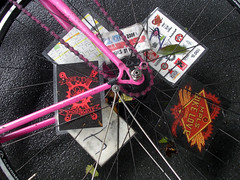
Cycling like a girl.


I hardly ever feel more like a minority as a woman than when I'm cycling. It is fantastic that the number of cyclists in London has increased an incredible amount over the last few years, but it is a sad and worrying trend that the vast majority of the cyclists in London are men. I refuse to believe that this is because women are afraid of 'helmet hair' or that they're worried that they won't be able to wear heels on their bike. I think this discrepancy has far more to do with the fact that women are conditioned from infancy to take up as little space as possible and to believe that they have little to no physical potential.

The statistics show that women are more at risk on the road than men. Of the 7 cyclists killed by HGVs in London this year, 6 of them have been women. Most fatalities involving bikes and HGVs happen when a lorry turns left and a cyclist is caught on the inside and gets crushed. It seems that male cyclists are safer because they are more likely to cycle faster and escape from the inside of the lorry, or to go round the outside of the lorry, into the traffic. Because of this, women cyclists have been encouraged to make themselves as visible as possible, ensuring that they are at the front of the traffic at red lights and as far forward as is safe. I believe there is a real feminist issue here about women being less willing to take up space due to a lack of confidence.

We've probably all allowed ourselves to be squashed up against a window on a bus or train because we felt bad for taking up too much room or just couldn't face the confrontation. Women are taught from an early age to be kind and to think of others before ourselves. We're also taught that we're not good at physical activities, that we should leave that to the boys. Studies show that parents vastly underestimate female babies' physical abilities and it's still the case that many schools still don't teach girls more boisterous sports like Rugby. The message from birth is that being strong and fast is not valued in women because it is not 'feminine'. In fact, girls and women that achieve highly in sport are often 'accused' of being gay. Consequently, many women are left doubting their physical abilities. Usually this only results in being a bit squashed on the bus, but now it may have led to the deaths of six women.

This insecurity is visible not only in statistics but also in the bikes that men and women choose to ride. My compulsion to check out other cyclist's bike is now chronic and I have put it to good use. My unofficial, mental survey reveals that despite the current trend/craze for fixed-gear bikes, few women are choosing to ride them. Instead, women seem to be opting for slow, stately 'Amersterdam' bikes. It's understandable in some ways, the fixed-gear scene is notoriously 'macho', but I fear that another reason is that women feel that they just won't be strong enough to ride them or that they are worried about how fast they are.

I'm by no means a Sporty Susan, but since I started to cycle a year ago, my fitness has improved, I've saved money and I'm completely independent. Cheesy though it may be, for me my bike is a type of freedom. I'm still not fully confident though. Despite sometimes cycling twenty miles a day and taking to my fixed-gear like a duck to water, I know that I could so easily become a statistic any and every time I hesitate or doubt myself. It pains me to see men constantly flash by women (including me) on their bikes. I don't know how we can change this though without women's liberation. Until the sexist culture around sports and physical activities is changed, many women will suffer from a potentially dangerous lack of confidence in their physical ability.

P.S. I recommend Iris Young's essay, 'Throwing Like a Girl' if you found this remotely interesting. It's fascinating.
P.P.S. If any women cyclists read this and are interested in setting up a regular women's bike ride in London, let me know by commenting.

Thursday, 25 June 2009

Racism, sexism and gang rape in the city.

This week, the subject of Channel 4's ever sensational Dispatches was gang rape. 'Rape in the City' (was that supposed to echo 'Sex and the City' in some perverse way?) featured testimonials from women and girls who had been gang raped as well as interviews with young black men about their attitudes to women and sex.

I watched this documentary knowing that it was going to make me angry for several reasons. Warning bells started to ring when I read the programme information; it was going to explore whether or not this is a problem with black men. We were presented with some fairly shocking statistics about gang rape and its perpetrators: 86% were committed by non-whites, 66% were committed by black gangs. However many times presenter Sorious Samura referred to these figures, there was never any in-depth analysis of them. If only 1 in 8 gang rapes are reported, how representative can these statistics be? And if it is mainly black men who are committing gang rape, where was the discussion of why?

Saying that it is because of a pervasive negative attitude towards women and female sexuality in this community does not go far enough. Sexism is pervasive in all sections of our society. It sounded to me worryingly like the racist idea that 'black men cannot control themselves' whereas white men can hide their contempt for women and keep their libido in check. It's telling that the first result Google finds from the search 'dispatches gang rape' is a post from far-right website Stormfront. It also seemed relevant to me that in almost all of the cases mentioned, these rapes were taking place on council estates and yet there was no mention of poverty and what role it may play.

The interviews with the young men were chilling but again, another important factor was skimmed over. It is hard to believe that young men were being entirely honest, there certainly seemed to be a strong element of sexual bravado involved. I have no doubt that young women are being treated in the horrific ways described by the interviewees, but perhaps their accepting attitude towards such behaviour was exaggerated.

From the testimonials of the young men interviewed and comments from the police, it seemed apparent to me that the focus of sex education needs to change. Young people know how to have sex, they even know about safe sex. The real problem that needs to be addressed is ignorance surrounding issues such as consent and its intricacies. They may not think about the fact that a woman or girl faced with many men who expect sex from her may be willing at first but the fact that she is outnumbered may men that she may not be able to change her mind without fear of reprisals. A police officer reported that one man arrested for a gang rape said that he didn't know that forcing a woman to give oral sex was rape. Whilst this is in many ways a separate issue from that of gang rape which is deliberate and intended to damage their victim physically and emotionally, an ignorance of issues surrounding consent cannot be helping.

Equally as galling was the way in which each girl's account of gang rape was introduced, with a brief rundown of her sexual history. One girl 'had only just started to date boys and was still a virgin'. What is the relevance of this please? If the girl in question had had sex with everybody at her school, it wouldn't have made what happened to her any less terrifying and appalling. Whether this stemmed from a belief on the part of the programme makers that raping a virgin is worse than raping a sexually active woman, or from a desire to sensationalize an already shocking documentary, it is reprehensible. Such sensationalism detracts from the gravity of what happened to these women, the horror of which is apparent from their brave and devastating personal accounts.

Having a black presenter does not make a programme immune from being racist. At a time when race relations in the UK are precarious, it seems irresponsible to make a programme that merely scratches the surface of what is an extremely complex issue. And given that the presenter talks so much about the denigration of women by men, it is sad and ironic that he uses the virgin/whore dichotomy to sensationalize a subject that could hardly be more shocking. This documentary is not going to help prevent future gang rapes or encourage a real productive discussion on this subject. It came across as a poorly researched, lazy 'shockumentary', which does the victims of this crime a disservice.