This is also posted at the F Word blog.
For just over three months, the National Portrait Gallery has been celebrating Gay Icons. This impressive exhibition features photographic portraits of people deemed iconic by some of the most famous and influential gay figures alive today. Alongside the main exhibition, the gallery has hosted a number of events designed to explore the meaning of the words ‘icon’ and ‘iconic’. On 25 of September, The Raincoats played as part of ‘Icon-i-coustic’, a series of concerts, held at the gallery, by iconic musicians and bands including Patrick Wolf and Beverley Knight.
Ana da Silva and Gina Birch formed The Raincoats in 1977, in the midst of the boy-dominated punk scene. By 1978, they were joined by Vicky Aspinall on violin and the legendary Palmolive, of The Slits, on drums. Their eponymous debut album, released in 1979, has rightly achieved iconic status. The Raincoats is the sound of women finding their own way of expressing themselves through music. Its off-kilter rhythms and feminist subject matter combined with Ana and Gina’s incredible vocals are like nothing else that came out of the macho punk scene. Their strictly DIY, lo-fi approach has been admired by other iconic musicians including Kim Gordon and Kurt Cobain, who wrote the liner notes for the 1994 re-release of their debut.
It’s easy to see why The Raincoats were chosen to perform at this event, then. But this was much more than a gig. All of the musicians in the ‘Icon-i-coustic’ series were invited to present their own icons before performing themselves.
Shirley O’Loughlin, the band’s manager, went first. There was a fantastically sinister reading of some choice passages from Valerie Solanas’ S.C.U.M. Manifesto and an equally creepy performance of ‘Blue Moon’ as well as a poem about, well, shoes.
Next up was Ana who had decided to present her icons to us in the form of illustrations; there was one for every member of the audience to take home. Peeking over other people’s shoulders I saw drawings of Pure digital radios and Telecasters. I got Raincoats lyrics, “My feelings were killed by laws, The walls that surrounded my city”, with a picture of two love hearts and barbed-wire.
Gina showed us a film in which she talked candidly about her icons, from the hippy movement to Tracy Emin, Enid Blyton to Vivienne Westwood.
There were few surprises here, except maybe Enid Blyton, but their icons reflect absolutely who they are as a band; dedicated to music, art and punk aesthetics, as well as being openly and unapologetically feminist.
And then it was time for them to play. They rattled their way through a 10-song set, which included favourites like ‘No Side to Fall Into’ and ‘No Looking’.
One of the most charming things about The Raincoats is that Ana and Gina have never been technically brilliant guitarists or bassists. They’ve found their own way of playing, one which is far more interesting than the three-chord punks or air guitar inspiring rock gods.
More than 30 years after the release of their first album, The Raincoats are as vital as ever. Their vocals, which range from lush harmonies (‘No Side to Fall Into’), to yelps and barking (‘Babydog’), represent women empowered by their creative freedom.
Watching women collaborate in this honest way is an intoxicating experience. After their final song (their excellent, queer cover of The Kinks’ ‘Lola’) I left more desperate than ever to be in a band with other grrrls. The fact that they continue to inspire in this way makes them more than worthy of the accolade of ‘Icons’.
Monday, 5 October 2009
The Raincoats play the National Portrait Gallery


Monday, 21 September 2009
Chris Brown: No more Mr. Nice Guy.
So I'm finally doing a Rihanna and Chris Brown post. Well, really just a Chris Brown post. I've put this off for a number of reasons. Firstly, I didn't see the point in writing a post when it first happened, just sort of saying it had happened and that it was terrible because, well, we all know that. Secondly, I wanted to see what happened to Brown in the months after the incident, his trial and his career. I feel that there's more to talk about at this point, mainly to do with the way Brown has dealt with the media.
I have to admit that I knew very little about Brown before this incident, not being particularly fond of the brand of dull as ditch-water r'n'b that he's been so successful at selling. From what I've read though, he was viewed as a real 'good guy', this was an integral part of his branding and image. Part of the shock people felt when this story broke was a result of this squeaky-clean image. And to be honest, many of his loyal fans continued to defend him on the blogosphere, some even going as far as to say that Rhihnna must have done something to deserve the brutal attack. Obviously Chrissywiss just isn't capable of doing anything his Mom wouldn't approve of. Men saying this is a worrying trend, but perhaps more worrying is that this defence often came from young women. Apparently there is a large group of young women out there who really feel that if they checked the text messages on their boyfriend's phone and accused him of cheating, they would deserve any violence that came their way. Or maybe they don't believe that, but they'd prefer to think that than accept the fact that Brown's behaviour was unjustifiable.
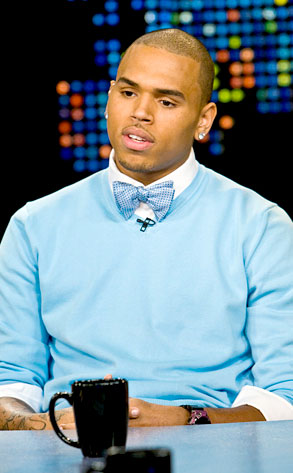
Then there is the apology. Call me cynical, but this came across as scripted (by a lawyer most probably) and a calculated attempt to create some closure and sympathy so that he could continue with his career. From his conservative (and, frankly, bizarre) outfit to his constant references to G-d, his mother and spiritual teachers, this was Brown trying to claw back his nice-guy image. His reference to the domestic violence he witnessed in his own home as a child, in the context of everything else he said, sounded hollow. Domestic violence is not simply 'uncontrolled rage', it's about entitlement and subjugation. The fact is, he felt entitled to hit Rihanna, probably because she's a women, an incredibly successful woman to boot.
Another public appearance, another ridiculous nice guy outfit. Brown appeared on Larry King's show with his mother. King asked him how he felt when he read the police report which details what he had done to Rihanna. His answer? 'I'm like, wow' and 'that's not the person I am'. Way to avoid answering there Chris. It clearly is the sort of person you are, you did it. This is obviously another attempt to distance himself from what he did, like it was another person who committed the abuse, not him. This is even more apparent when he claims that he doesn't remember it happening. Oh, using the old 'blackout' excuse there are we Chris? He clearly isn't worried about becoming a cliché. Brown never really addresses what he did, he never answers anything. It strikes me that it is only men who get away with this behaviour. Where womens' lives are scrutinised, men are often allowed to bluff their way out of uncomfortable situations.
It's a shame that Rihanna doesn't have the luxury of escaping from what happened, the leaked photographs of her abused face preclude this. She's been blamed for teaching girls that abuse is acceptable (because she accepted his apology and apparently took him back) and has been criticised for appearing in raunchy photo shoots, with people questioning if this is acceptable behaviour for a domestic violence victim (survivour). Brown seems to have avoided this level of scrutiny despite the fact that he was convicted of a violent crime. It seems there is no limit to the amount of blame that women are expected to shoulder.
At this point, it's hard to say whether Brown will go on to regain his success. His fans, or former fans, seem to be split roughly between postions that almost condone his behaviour and a sort of patriarchal, 'you don't do that to a woman, I want to beat him up'. He does seem to have lost the respect of lots of young fans though, which is generally positive (it would be better if it came from a place of gender equality rather than wanting to protect Rihanna's honour), but I'm sure many will just accept his apology and continue to throw girl-hate at Rihanna. It almost makes me wish I was a former fan, just so that I could stop buying his records.
Thursday, 17 September 2009

Thursday, 10 September 2009
Riot, grrrls.
A couple of months ago I blogged about what it means to be a female musician today. Recently I've been thinking about what it's like to be a female music fan/geek as well and I've decided it's just as weird and shit. This was summed up for me the other day when I was in Sister Ray, a record shop in Soho, and I was the only woman there. And this isn't a one-off. I've always found independent and second hand record shops to be full of boys. The same goes for gigs, at a fairly recent Sonic Youth gig I attended girls were outnumbered by boys by at least three to one.
Are girl music geeks invisible on the music scene? Are there thousands, even millions, of us listening to bootlegs and b-sides in our bedrooms feeling intimidated by the macho atmosphere of many gigs and record shops? Absolutely. I know I was worried recently when I thought I was going to a Sonic Youth gig (yes, another one) alone. Last time was pretty rough, everybody was taller than me, male and going nuts. There's no way I'm going to hide away at the back when I could be thrashing about at the front but it's always good to know that you have a friend there to haul you up from the floor if needs be. There's also the problem for girls at gigs that some horrible boys will use their proximity to you, and the fact that you are stuck, to get 'handsy'. This can range from people rubbing up against you and groping because they think you won't notice in the throng (I did notice, and I know you noticed my elbow in your ribs and the bruise it must have left), to more serious sexual assaults and even rape and gang rape (during Limp Bizkit and KoRn at Woodstock). Most women who attend gigs will have dealt with some sort of behaviour on this spectrum.
I've written before about women feeling like they can't take up space and I think this is apparent at gigs which can become dangerous. It's safer to move and thrash along with everybody else than to stand still in the midst of everything and get trampled. Perhaps we're too scared to be rude to the asshole rubbing up us because we're taught to be polite and that if he gets angry we won't be able to defend ourselves. I remember being so pleased that I wasn't wearing a skirt as I crowd-surfed my way out of Pixies at Reading Festival, you hear of so many girls being violated in that situation.
And if it wasn't crap enough to fear being assaulted at a gig or embarrassed at a record shop, we also have to look out for girl-hate based on our love of music. If you wear a band t-shirt you face girls talking behind your back, 'She's just wearing it coz she thinks it's cool. Eurgh, I hate girls like that, it's so desperate.' People who wear band t-shirts of bands they don't like are lame, but why assume that somebody isn't a genuine fan just because they're female? I'm sure her boyfriend wouldn't be accused of being a shallow hipster if he was wearing it. I almost feel that some girls view themselves as the only real female music fan in the world, the rest of us are faking to get a boyfriend. I'm not saying you should be friends with every girl you see wearing a t-shirt of your favourite band, but I wish people would acknowledge how sexist and macho the alternative music scene can be and not buy into that bullshit. I'm reminded of a couple of my favourite points from the riot grrrl manifesto:
BECAUSE we are interested in creating non-heirarchical ways of being AND making music, friends, and scenes based on communication + understanding, instead of competition + good/bad categorizations.
BECAUSE we are unwilling to let our real and valid anger be diffused and/or turned against us via the internalization of sexism as witnessed in girl/girl jealousism and self defeating girltype behaviors.
I want girls to be happy when they see another girl in a t-shirt, it means more female faces at gigs. We should be getting stuck in at the front with our girl friends, teaching those boys who take advantage of the fact they're lucky enough to be near us in all our awesomeness exactly what happens if you touch us without our permission. One last point from the riot grrrl manifesto:
BECAUSE we know that life is much more than physical survival and are patently aware that the punk rock "you can do anything" idea is crucial to the coming angry grrrl rock revolution which seeks to save the psychic and cultural lives of girls and women everywhere, according to their own terms, not ours.

Sunday, 6 September 2009
Want to be a hipster girlfriend? Look like a child.
It's probably not that surprising that an American Apparel advert has been banned. For the last few years they've consistently produced adverts featuring young women spread-eagled in their boyfriend's underwear, on all fours in hot-pants or topless in gym wear. It's not clever or interesting, just quite grim when you consider that the CEO, Dov Charney, has been accused of sexual harassment and once masturbated in front of a female journalist.
The reason it's been banned is that the woman looks as if she is under sixteen, and also because it is said to resemble an 'amateur-style photo shoot'. I'm not sure if I think the model looks THAT young, but the latter part is true. American Apparel have claimed the ad demonstrated that the hoodie is "soft to the touch" and that the model was not supposed to be viewed as"a sex object or in a negative or derogatory light". (Ta, Guardian) I'm sure I'm not alone in finding that hard to believe. After all, these photographs show a young woman gradually gradually revealing that she's topless under a hoodie whilst wearing teeny tiny shorts.
But it's not the most controversial of their adverts that I've seen. Check out this. I wonder if they would also claim that this was not sexual? When I first heard about this story, I really thought (hoped) it would be this one that had been banned. I'm sure that none of the models are actually under age, Ryan from the banned advert is 23, but they point is that they look young and vulnerable which is unsettling to say the least.
They've also tried to justify the ad by saying that because it ran in Vice magazine, it was unlikely to cause offense. I would agree that the ad won't have been the most sexist, offensive part of Vice. In fact, using very young looking women wearing very little in their photo shoots is something that the magazine is pretty obsessed with. A recent issue featured an extremely young and ill looking woman in a little blue swimming costume, playing about like a child. Ew. There's certainly a weird Lolita-esque thing going on in hipster lifestyle catalogues these days. The models appear as children, but are posed so as to that suggest they would be crazy in bed. Again, ew.
American Apparel has been lauded for the ethical way it treats it's LA base labour force, and this is certainly commendable. However, the way the women on its workforce are constantly simultaneously sexualised and infantilsed in its advertising is reprehensible. I guess it's understandable in a society that still wants women to be subservient and pure, but also up for having sex all the time. These American Apparel adverts are nothing more than pictorial representations of this tension and they deserve a collective 'YUCK' from the women they want to sell to.

Sunday, 23 August 2009
Black models as 'Wild Things'
So, we all know there are myriad reasons why the fashion industry is terrible for women (and I say this as a Vogue reader who wrote 1000 words on what to wear to 2008 Christmas parties). It makes us feel bad or not being sample sized, for not having enough money to buy designer or keep up season to season. But one of the things that has really struck me over the last few years of being a fashion junkie, is that it is often blatantly racist. I'm referring to the lack of black faces in magazines but also to the way black model are exotisised and fetishised when they do grace the pages.
I was going through a pretty heavy obsession with Stefano Pilati's YSL Autumn/Winter 2008 collection when I found this quote from the man himself on black models:

“To me, it is a matter of proportions and the bodies I choose. My fit model was a black model. When I wanted to translate what I put on her, it was a disaster. It would need 13 times more work in the atelier to modify it to put on a more Caucasian anatomy. Sometimes, it’s not your choice. You can’t find “black models” that are beautiful and with the right proportions. I prefer them with lean proportions with no big hips.”
Wow. This is the current creative director of Yves Saint Laurent, a label who were among the first to regularly use black models in their catwalk shows. So we're supposed to accept this as an explanation? That black women never have both beauty and the 'right proportions'? I call bullshit. If Pilati can't make his clothes fit, that's his problem. He can't blame ALL BLACK WOMEN for his shortcomings. Models are considered to be the most beautiful of all women. If black women aren't represented in the industry, it's tantamount to saying they are not the right kind of beauty.
And if a black woman does make it into the big time as a model, she can expect to be treated pretty much as a novelty. A sexy, exotic novelty. I writing about this now because of this. What a surprise, the fashion industry's chosen black woman cavorting with animals in Africa. The spread is even called 'Wild Things', implying that Campbell is 'wild' like the animals that she's photographed with. All woman have suffered from this idea that women are close to nature and somehow more earthy and elemental than men, but black woman are constantly portrayed in this way. Photographs of black models are often far more sexual than those of their white counterparts, they are naked far more often. It seems to me that the fashion industry views black women as wild and sexual and white women as beautiful and ethereal.
It's interesting then that Naomi Campbell appeared naked on the cover of i-D magazine with Stefano Pilati last year. She hasn't shied away from calling the industry out on its prejudices saying,
“Women of colour are not a trend. That’s the bottom line. It’s a pity that people don’t always appreciate black beauty. In some instances, black models are being sidelined by major modeling agencies.” (
The pictures of her, naked and pressed up against Pilati fit in perfectly with the way that black models are sidelined. The things is, it is hard for black models, even those as famous as Campbell, to be constantly addressing issues around racism. What they say would no doubt be distorted by the media, and often the problems are so complex that they would never been given a platform to express them. They are expected to be spokeswomen where white models never are. There's certainly an argument to be made that if black models turned down these jobs, the industry would have to change. This isn't necessarily the case though, and in such a precarious and fickle industry, it would be easy for photographers and editors to simply replace models who refused shoots. Far more problematic though than Campbell appearing in this shoot, is Pilati's involvement. Does he really think that embracing a naked black women absolves him of racism?
Campaigning for representation of women of all ethnic backgrounds in magazines is important. What may be more important is ensuring that the industry does not get away with vile, racist stereotypes when they do decide to use black models.
(The quotes from Pilato and Campbell come from Stylefrizz.com)
Thursday, 13 August 2009
Filament magazine and the female gaze.
'Filament' is a new magazine for women which describes itself as, "72 quarterly pages of intelligent thought and beautiful men". It doesn't run articles on fashion or cosmetics and prides itself on publishing high quality, intelligent features as well as pictures of hot boys not wearing very much. Sounds AWESOME.
I love the fact that they have done their research rather than just going along with the notion that women don't find visual stimulus exciting. They found that women really wanted erotica, and that the images they wanted to see were not the same as the ones common in gay porn. They found that women wanted:

* men with more feminine face shapes
* men with attractive faces
* images that show the subject’s character and the environment he is in.
The problem is, they also found that women wanted more than just semi-nudity. They were asking to see fully naked men with erections. OK, fair enough, walk into any newsagent in the land and you'll find the female equivalent of this. Up above Cosmo, Heat, Vogue and Grazia you'll probably come face to face with a women on a magazine cover with breasts bigger than your head, grabbing at herself 'passionately'. Except their printers said they were concerned about causing offense to "the women's/religious sectors". So women are going to be offended by erections but not page three girls, religious groups are going to be more upset by a boner than a female crotch-shot? Oh, please. This is almost certainly another attempt to deny female sexuality, and to 'protect' men from it.
I'm sure that many people will disagree with me, but I tend to agree with Kristina Lloyd and Mathilde Madden at The Guardian when they say,
"But there's nothing inherently sexist about depicting nudity. It's sexist when only women are deemed to signify the erotic; it's sexist when eroticised images of women are so normalised and widespread that women stand to be viewed first and foremost as sex objects – their value inextricably linked to their sexual desirability. The sexism is in the inequality."
Don't get me wrong, I'm not a fan of the porn industry and I have a special well of hatred reserved especially for lads mags. The thing is, I don't think that all sexual images are necessarily exploitative or degrading. Nudity and sexuality shouldn't be frowned upon, after all, do feminists want to be on the same side as people who have denied female sexuality for eons? It's the industry that often deserves our scorn. 'Filament' say they are dedicated to ensuring that the men who model for them are treated fairly. Models have the right to withdraw their images and the team have even turned models away when they feel that working for 'Filament' may not be a good career move for them.
I'm willing to bet that a lot of lads mags editors would say a similar thing. The problem there is that it ignores the fact that many young women are growing up now believing that their only worth lies in their sexuality. Women's ability to really choose any involvement in the sex industry is often more problematic than it is for men because of intense societal pressures. Even women's magazines constantly impress upon women the importance of 'pleasing your man'. Women's sexuality is dictated to us by the mainstream press which defines it as passive and willing to please but never demanding. In other words, in a classically post-feminist marketable way.
I think a publication that acknowledges female desire and caters for it, as well as promoting positive body images and providing intelligent comment should be applauded. It worries me that there seems to be two main camps on porn and female sexuality: the 'all sexualised images are wrong/women don't want to look at cock' camp, which is inhabited by some feminists as well as religious and right-wing folk and the 'women are really nothing but a pair of tits and should act as such' camp inhabited by the editors of lads mags and the lads themselves. Neither positions are realistic or helpful. Although I think lads mags are beyond reform (due to the blatant misogyny of the articles that goes along with the images), I'm happy to see more women behind the camera in porn and erotica.
Subscribe to:
Posts (Atom)

